

Becoming a polyglot
When I was a kid, most of my friends wanted to be doctors, football players, hairdressers, vets, or firefighters (no YouTubers back then!).
I wanted to be “a polyglot.” I discovered the words when I was 7 or 8, and I told my parents that’s what I wanted to do as a grown-up. Deep down, what I really wanted was to travel the world and discover the fascinating places with exotic names on the world map at home.
“Were they real?”
Learning languages was the best way to find out…
As it turns out, the places were real and being a polyglot became the story of my life…
Due to my dad’s job, I spent my childhood and teenage years across different countries and continents. By age 15, I had lived in Spain, France, Brazil, and the Netherlands. Every time we moved, I loved learning a new language, but I also hated it because my accent reminded me that I was different, and children don’t want to be “different.” They want to belong. So I tried really hard to sound “like them” and get rid of my Spanish accent.
In high school, I took every opportunity to learn a new language: English, German, Italian…I remember buying 4 mini-dictionaries at once, because back then we didn’t have iPhones or Google Translate.
The obsession only grew stronger, and at Uni, I applied for an internship and graduated from Law School in Bologna. I wasn’t interested in law, but I was very interested in Italian (and Italians, ha!). Once I finished my studies and couldn’t find a job in Spain, I packed one brown leather suitcase and moved to China as an intern for the Spanish government. Mandarin became the 6th language.
Different people have different motivations for learning a new language: career opportunities, love, money, cultural immersion… for me, language was the motivation in itself: a superpower to communicate and connect with millions of people by switching channels in your brain.
Substack-ing in a second language
And connecting with people around the world brings us to today.
In November 2024, 18 months after my debut on Substack, I launched my Spanish publication, El Limonero.
Excitement was high, but expectations were nonexistent because Substack is an English-dominated platform and I hadn’t seen much Spanish (or other languages). I didn’t care and gave it a shot anyways…
What’s the worst best that can happen?
I had never written in public in Spanish, and this new passion project became the perfect opportunity to build a bridge to reconnect with my roots. Having spent most of my life as a foreigner, growing my own Spanish community felt a bit like home away from home. I was closing the loop.
It’s been a bit over one year and what started as a little seed has turned into a beautiful lemon tree, or limonero 🌳🍋
While I don’t have huge numbers or a Substack Bestseller badge, I have a lovely community of over 2,800 Spanish-speaking writers, authors, creators and solopreneurs across 72 countries! And now I know these places do exist ;)
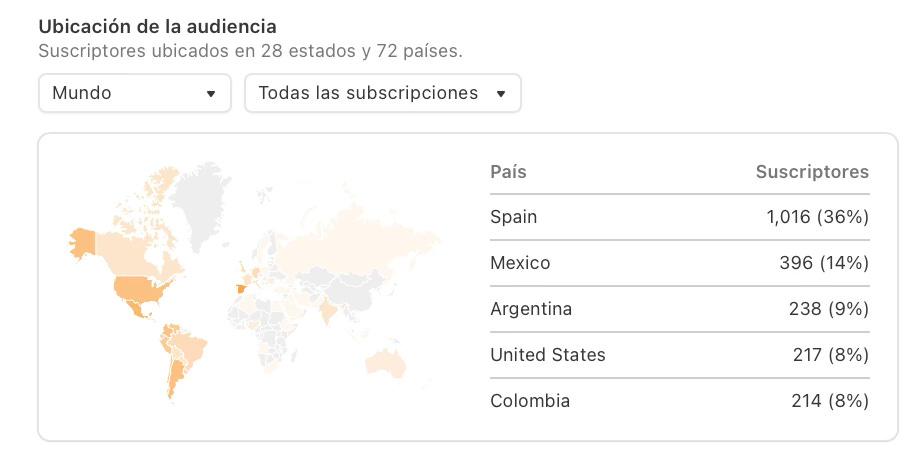
It’s been a wonderful journey and my goal with today’s newsletter is to encourage people to get out of their comfort zone and live life in different languages.
Unlike when I was growing up, today you don’t have to move to Taipei to learn Chinese or pay an expensive tutor to study French. The possibilities are endless and accessible and you can even subscribe to brilliant publications for free in your favorite language!
Ready to launch your Substack in a second language?
If you are ready to launch your Substack in a second language or are curious about my experience, in this 18-minute video, I share my strategy and tips to help you successfully grow 2 publications without burning out.
Some of the questions I answer:
Which language you should launch first.
When is the ideal time to launch the second publication.
Is it better to keep the same profile or create a second one?
Why it’s important to create independent publications.
How Notes work for multilingual creators (and how to ensure you are seen)
Strategies to create synergies between platforms (my English publication helps me grow my Spanish one).
Tips for cross-promotion and monetization
To make the experience smoother, I have just launched my YouTube channel and you can watch all my videos there for FREE:
Other resources for language lovers
I’ve also curated a list of FREE resources and multilingual creators in my community.
Also, if you want a customized 1:1 strategy session to map out your Substack growth and monetization plan in 1 or 2 languages, you can become a Founding Member.
📝 My Substack Journey in 2 Languages: Is It Worth It?
🎬 Live: Mastering Multilingual Substacks with Katja Groesser
Other multilingual creators in my community based on language:
🌎 Viktoria Verde, PhD has a wonderful publication, How We Learn Languages.
🇪🇸 Spanish: Rosemary DeSena (Poetry), Pablo Renaud (ecommerce), Rodolfo Paiz (Family business), Juliana S. (Bilingual families), Maria Garai (personal growth)
🇧🇷 Portuguese: Carolina Wilke (Purposeful business)
🇫🇷 French: Philippe PICARD (Solopreneurs), Kathy Bonenfant (Minimalism)
🇮🇹 Italian: ✍🏻Rebecca Dawn (Self-improvement)
🇦🇪 Arabic: Natasha Tynes (Ghostwriting)
PS: If you write in a second language, feel free to add it in the comments, and I will edit the list👇🏽
Thank you for reading! If you made it this far, you have officially made it to language lover 🌎❤️
And if you enjoyed it and would like to give me a little boost, please comment and share it with your multilingual buddies.
Gracias 🙏🏼


