
From 121 Subscribers to Substack Bestseller in 6 Months
#2 in Rising in Education. No strategy, no team, no plan. Here's what happened.


My welcome email to new subscribers starts like this:
“This is not a newsletter; it’s a community.”
My vision at The Lemon Tree Mindset is to grow a cozy corner where creative entrepreneurs genuinely connect, share and collaborate. And while it has grown to a few thousand subscribers, its shade is still big enough for everyone to fit in.
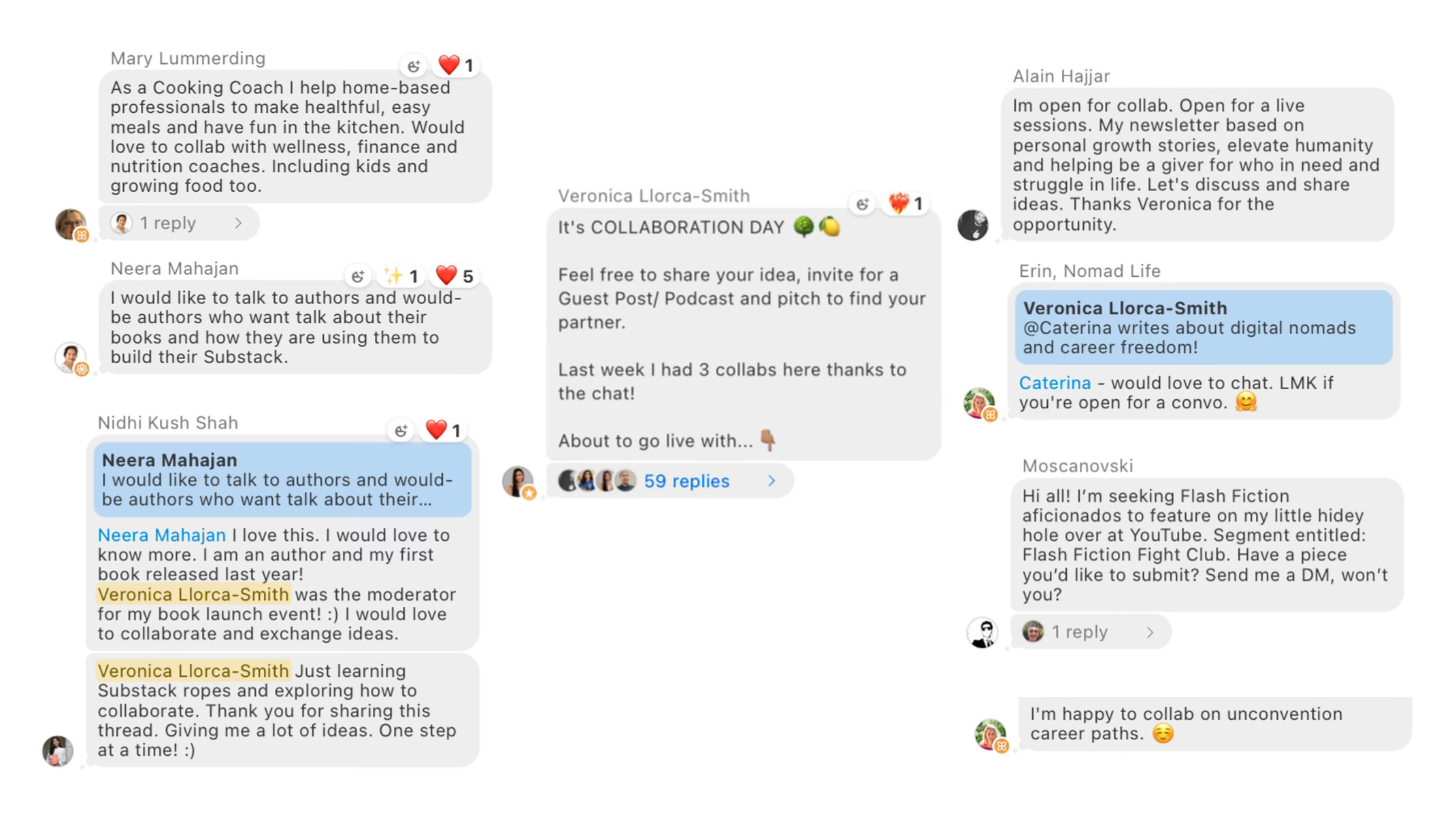
Every week I host an open COLLABORATION day in my Group Chat. This is totally FREE and my goal is to encourage people to connect, meet other creative entrepeneurs and build new partnerships. I mean it.
I also love showcasing the incredible talent of my Premium Members through Guest Posts:
Charlie Garcia shared with us the mind-blowing strategy that took his publication from zero to 900,372 US$.
Fleur Hull became a Substack Bestseller by growing a publication that helps indie authors succeed.
Shelly Roberts shared with us the launch of her lovely Book Club Podcast.
Marylee Pangman, Author started writing fiction at 72.
Meet Viktoria
Inspiration is everywhere, and today it takes us to Sweden, where my premium member Viktoria Verde, PhD shares with us her incredible journey on Substack.
Viktoria is a full time working mum, yet in only a few months, she has grown her publication, How We Learn Languages to a Substack Bestseller with over 15,000 subscribers. She often leads the global ranks in Education and today she will share her secret with us.
Last week she actually invited me to write a Guest Post on my journey towards learning 6 languages and how it shaped my business and my life:
The Quiet Way Languages Became My Path
And today, it’s an honour to introduce her to you.
Welcome Viktoria!

Six months ago, I had 121 subscribers and one paying reader.
Today, my Substack is a Bestseller. I have been holding spots in Rising in Education and Subscription Bestsellers since April, with rankings that move around day to day but keep me on the boards. More than 15,500 subscribers. 147 paying for the deeper work.
I am still trying to absorb what happened. None of this was planned, and most of it surprises me.
I have no background in marketing, business management, or sales. What I have is a PhD in Applied Linguistics, 8 languages (2 mother tongues - Russian and Belarusian + 6 foreign languages acquired as an adult), 20 years of teaching under my belt, and a burning passion for languages since I turned 16. I started learning English as my first foreign language at that age and discovered an unimaginable love for languages. The languages that followed were Polish, German, Spanish, Swedish, and Italian.
I used to be a chronic perfectionist, and as a result, a chronic procrastinator. I polished my PhD dissertation into oblivion, then removed 30% of it and three years of daily writing with it after a new supervisor told me it was too much, too sophisticated, and that we needed to simplify. I overprepared every lesson and used maybe 10-20% of what I had.
I delayed action until I had a perfect plan.
Until one day, I decided, “Viktoria, that’s enough. No more of this!” Now I act. I do stuff. I fall and rise stronger and wiser (I hope).
Right now, I am learning on the go. Daily and obsessively. I act, make mistakes, learn from them, and adjust. Learning by doing is my motto.
I prefer this way now, because it brings visible results.
Why I am doing this
For 25 years, I’ve carried this love language learning and teaching in me and shared my knowledge and experience only with a limited group of people. Essentially, my reach was the size of whatever room I was teaching in.
Another thing that has bothered me for years is the unnecessary complexity and exclusivity of the science of second language acquisition (or any science field, in fact).
The fascinating science of how languages are acquired sits behind academic paywalls, often written in a language few people outside academia can easily decode. It feels as if it were reserved for an elite circle of people who happen to know the jargon and are in the habit of reading difficult academic texts.
Meanwhile, millions of people are trying to learn languages using contradictory methods that promise fluency in 30 days (Reader, please, don’t be misled. Language learning is a complex process that takes years).
My small mission is to close that gap. To take the original research and translate it into something people can read, understand, and use in their own lives. That is the whole point of my publication How We Learn Languages.
My Results (May 10, 2026, 11:26 Stockholm time)
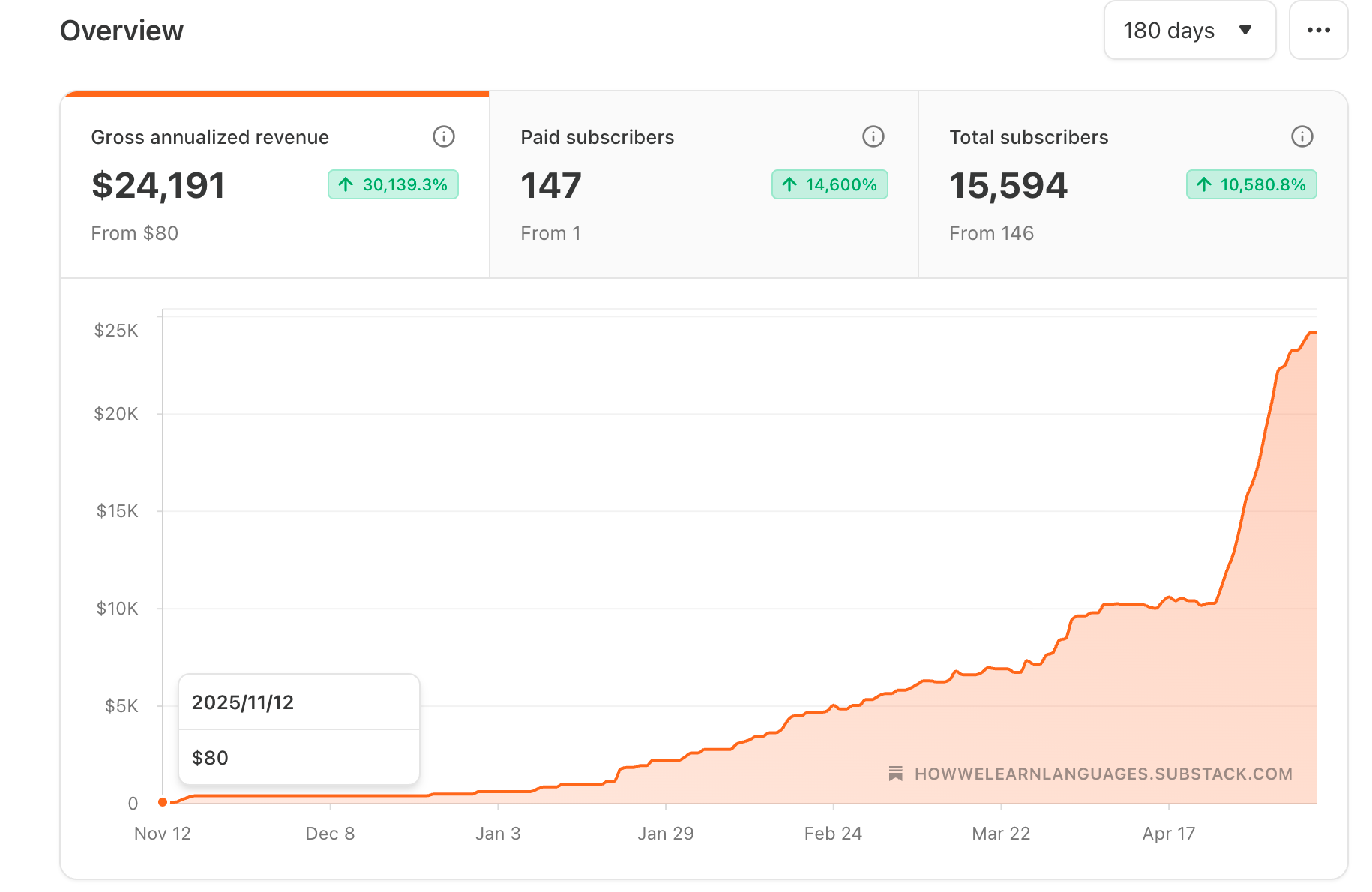
I had second thoughts about sharing this screenshot.
I did not want to be perceived as boastful or demotivate anyone who is not there yet. But I decided to share it anyway because I think the opposite might be true (and because that’s what Veronica’s audience wants :)).
If you are in your own slow months right now, you might need to see that things can shift. The numbers are real, and they came from someone who had 121 subscribers in February. That someone is me, but it could just as easily be you in a few months.
The money came as a surprise. It was never the goal, and I want to say that plainly so the screenshot is not read as something it is not.
The slow beginning
I published my first Substack post on August 18, 2025. Start Here: Welcome to How We Learn Languages.
I was not sure I would continue. I had been writing on Medium for about 6 months and was starting to find my footing there. I still write on Medium (albeit much less now), where I have around 23,000 followers, and I run my own publication there, Language Mind, open to submissions from other writers. Substack felt new and uncertain. I was testing the water.
I posted Start Here, then went quiet. One piece in September. Nothing else. I was watching to see how the platform felt, whether anyone would care, and whether it was worth my time.
On October 13, 2025, I committed. I started posting consistently. Two articles a week. No exceptions.
For five and a half more months, growth was slow.
A handful of subscribers here and there. I watched the numbers crawl from 50 to 121 to 500 to a few thousand, and I celebrated every hundred, because every hundred meant a hundred real people had decided my work was worth their attention.
By the end of March 2026, more than seven months after my first post and almost six months after I committed to consistency, I had under 3,000 subscribers. That was the entire result of what I considered my best work.
During those quiet months, I did two things. I wrote. And I learned.
I studied writers who are talented at growing on Substack, people like Veronica Llorca-Smith, whose publication you are reading right now. I paid attention to how they communicated with their audiences, structured their welcome emails, announced upcoming content, and built trust through consistency.
All in all, I learned a great deal from watching others do it well.
And I made a promise to myself: I will try not to miss a day. Whatever happens, I post Notes, I publish my articles, and I show up. I have bad days, low days, self-doubt days, fatigue days, sleep-deprived days, and on those days, I keep reminding myself it will pass. It is just emotions, hormones, temporary feelings, and unfortunate life circumstances. Tough, but I can manage.
After all, I am on a life mission to communicate science and bring real knowledge to people. That mission does not take days off.
What I did not know in those slow months: I was not failing. I was building the foundation that April would stand on.
What I am doing now
My publication is not a newsletter with random posts on random topics. I don’t treat it as a hobby or a side hustle (I hate this word, btw).
It is a structured, science-based program on how languages are actually learned. Designed to run for years, like a university program. It has a framework. It has layers. It builds over time.
I publish three articles per week now. Two anchored in the running series (Tuesday free, Thursday paid), one weekend post outside the series for variety. The articles have been long from the start, often 5,000 words.
I never experimented with shorter formats. I am a scientist, and I love depth. I cannot live with shallow coverage of important topics, and I knew from day one that I would rather write fewer pieces and go deeper than chase the algorithm with shorter ones.
The free articles are not lighter versions of the paid ones. They are full deep dives in their own right. The paid articles add the action framework and implementation tools (worksheets, planners, trackers, self-assessments) that turn theory into practice.
I want to give my readers more, not less. That part is not a strategy. It is just how I think about the work I do. Massive value is always at the center, regardless if it’s a free subscriber or a paid one.
Every article is grounded in published second language acquisition research. I read the original peer-reviewed papers, not summaries or blog posts about them. And I cite my sources properly.
I write about science the way I would explain it to a non-linguist friend over coffee. With stories, metaphors, and my own experience as someone who learned eight languages starting from a small Belarusian town.
But writing and research are only half the job.
The other half is communication.
I try to reply to every comment. Sometimes one gets lost in the stream and goes unanswered, and if that has ever happened to yours, I am sorry; it was not on purpose. I answer DMs when I can. I treat every reader who shows up like a person rather than a metric, because that is how I think people deserve to be treated when they trust me with their attention.
It takes an enormous amount of time, on top of a full-time teaching job. I knew when I started that the pace would be hard to keep up. I started anyway, because the work felt meaningful.
Then April happened
In April 2026, six months of consistent, mostly invisible work suddenly became visible.
I gained more than 12,000 subscribers in a single month, with a thousand new readers a day at the peak. 88% of them found me through the Substack app itself. I did not drive them there. The algorithm picked up the work and started recommending it.
I became a Substack Bestseller. I climbed onto the Rising in Education leaderboard and the Subscription Bestsellers list, and I have held spots on both ever since.
As you can tell by the shape of the chart in that screenshot, five months look almost flat, and one month (April) looks almost vertical. I was still putting in the same effort. I didn’t introduce anything new. The difference was time and patience.
Some of that growth came from the algorithm, as I came to believe. Some of it is from consistency. But some of it came from one specific reader, and I want to thank him properly here.
A Founding Member of mine, a 75-year-old international operations executive who writes under the name Maximus Skepticus had spent fifty years trying every language program he could find. He joined my Founding Member tier, where I design a fully personalized language learning plan based on each subscriber’s goals, schedule, history, and target language. I built his plan. He started using it.
Then, unprompted, he wrote two long articles about his experience and published them across three platforms (Substack, Medium, and LinkedIn).
I did not ask him to write those articles. I did not know he was writing them. I learned about the first one when readers started arriving at my publication, mentioning his name.
So this is the place to say it directly: Thank you, Maximus Skepticus. For the trust, for taking my work into your own life, and reporting on your progress. I will not forget it.
You can read his articles here:
If You’ve Ever Struggled to Acquire a New Language, Your Anguish is Over
UPDATE: If You’ve Ever Struggled to Acquire a New Language, Your Anguish is Over. Part Deux.
There is also something to learn from this.
When you build something carefully, with real dedication, for one person, that person sometimes tells others. The other people come and tell other people. Word of mouth is more powerful than any algorithm, in my view. I always do my best without expecting anything in return.
I did not see any of this coming. I thought maybe, with consistent work, I would reach 10,000 subscribers in two or three years. It happened in less than 6 months, almost all of it in the last one, and I still find it hard to comprehend.
Where the work ethic comes from
I moved from Belarus to Poland 20 years ago. I was 20 with no money and no support from my parents. They were simple factory workers who lived on a small salary that barely covered basic living expenses. I dropped out of Minsk State Linguistic University (everyone thought I was out of my mind) and got admitted to the University of Warsaw on a full-time program at the Institute of English Studies.
To make a living, I worked full-time evenings and nights at a call center serving the UK and US markets. Between calls, I prepared for my exams, read for my classes, and wrote essays at three in the morning. I slept in fragments. I lived on instant coffee and pasta.
It was tough, and I am grateful for it, because the years made me harder to break. They are the reason I can do this now: a full-time teaching job, a more-than-full-time Substack on top of it, two small children, and very little sleep. The Warsaw years gave me the durability.
Whatever I am building, I keep showing up for it.
The accidental live stream
A few weeks ago, after another sleepless night with my baby, I was at home looking exactly like someone who had not slept: puffy face, rough hair, a home T-shirt with what my mother later informed me was a visible food stain, almost certainly the work of my fifteen-month-old son.
I had been curious about Substack’s live feature. I wanted to see what the room looked like, how the interface worked, whether it was something I might use one day when I had more energy and, ideally, cleaner clothes.
So I clicked Go Live. To test it. Just to see what would happen.
People started streaming in.
Comments and questions appeared. I froze. My hand intuitively reached to close the web browser. Then, with a trembling voice, completely unscripted, I started talking. About my publication, about myself, about language learning. I answered questions while my heart was pounding and my thoughts were going astray. I was still trembling when it ended, not fully sure what had just happened.
But people stayed and listened. They asked real questions and subscribed. Authenticity, even accidental, seems to resonate more than polished, scripted performances.
Now I know how the live feature works on Substack and just announced Ask a Linguist LIVE, a recurring biweekly Q&A where readers leave their questions in the comments and I go live to answer as many as I can.
What I think actually works
Everyone knows Notes are important. Everyone knows consistency matters. I am not going to repeat what you have already heard a hundred times.
If I had to compress what I have learned into the things I would tell another writer starting now, it would be these:
Write from obsession, not from strategy. Not what you think will perform or what the algorithm rewards this month. Write about the thing you cannot stop thinking about. Readers can feel the difference between someone writing from the center of their life and someone performing expertise for an audience.
The obsession is the strategy.
Build a structure, not a stream. A newsletter is a stream of posts. A program is a structure. Mine is designed to work like a university course with a unified framework, layers that build over time, and a curriculum that grows. When readers see the architecture, they understand they are joining something that goes somewhere. They stay because the next post is connected to the last one, and to the next.
Depth is a competitive advantage. Most writers are publishing short, punchy, algorithm-friendly content. I write 3,000 to 5,000-word research-backed deep dives with full citations. That should not work. It does, for me at least, because there is a hunger for depth that the internet has almost completely abandoned. Readers tired of shallow content seem to find their way to writing that takes them seriously.
Be patient longer than feels reasonable. I gave my publication six months of consistent work before anything visibly changed. Most writers quit before they reach the point where compounding starts. The most useful thing you can do in your slow months is refuse to interpret slowness as failure.
Experiment relentlessly on top of consistency. Once your foundation is steady, the difference between writers who plateau and writers who keep growing is whether they keep trying new things on top of what is already working. Notes, lead magnets, new formats, live audio, collaborations. Most experiments will go nowhere. A few will compound into the next stage.
Give more than you say you will. If you say you will send a 1,000-word welcome guide, send a 5,000-word one. If you offer a personalized plan, build it as if the person were the only reader you would ever have. Word of mouth is built on the gap between what people expected and what they got.
Treat every reader like a person, not a metric. Reply to comments. Answer DMs. Build something that respects their intelligence. I have never used the word “avatar” to describe my readers. They are curious people who are tired of guessing. That is who I write for, and the rest followed from there.
What is next
I have ideas I cannot fully execute yet. A podcast. Ask a Linguist LIVE, already announced and starting soon. Live conversations with other writers and experts. Lectures. More collaborations. I want this to become more than a publication. I want it to become a place where people gather around the science of language learning and feel at home.
Mostly, I want to be able to give even more time to this work that fulfills me and to the readers who have made it possible. Hours to read more research, write more, build resources, collaborate more, and connect more with you in live streams.
A huge thank you!

A picture of me in Stockholm near my home.
I want to end with the part that matters most.
Whatever this publication is now, it is because of the readers. The 15,594 of you who showed up, the 147 of you who decided the deeper work was worth supporting, the ones who comment, the ones who DM, the ones who quietly read every Tuesday and Thursday and never say a word, you are the reason any of this exists.
I posted my first piece on August 18, 2025, not sure I would continue. By the end of March, after six months of consistent work, I had under 3,000 subscribers. Today, six weeks later, there are far more of you, and I think about you when I write. I would not have any of this without you, and I want to give more back, not less.
The thing I was not sure about in August has become a real part of who I am. Brick by brick, on limited sleep, with you on the other side of the screen.
Find me
Come find me on Substack. The publication is called How We Learn Languages. Start with the Start Here , The Course , and About pages. If it sounds interesting, read some free articles. See if they resonate.
If you have always wanted to learn a language but never found the right way in, you are exactly who I built this for.
And if you are in your own slow months right now, I would love to hear where you are. Drop a note in the comments.
Thank you for reading!
Viktoria Verde, PhD, is a linguist, polyglot, and certified language teacher of English and Swedish based in Stockholm. She speaks eight languages, has taught for over twenty years across three countries, and writes about the science of language learning on Substack (How We Learn Languages) and Medium, where she has 23,000 followers and runs her own publication, Language Mind, open to submissions from other writers.
Lemons & Lemonade 🍋
I’m sure you are as inspired as I am. This is the type of incredible talent you meet at The Lemon Tree Mindset and why I want you to be a part of it ❤️
If you need help growing your community and turning your hobby into your lifestyle, I’m here to help, and if you need a little push to take action, check out my new course, The Anti-Procrastinator 🎯(based on my book with Penguin).
This is your call to build habits that stick.
89 US$++ only instead of 128 US$++.
The early bird deal expires on 31st May.

 | A guest post by
|
Wonderful read, what a journey you’ve been on! Having learned many languages as well, I related to much of what you said. Well done and congratulations!
Thank you so much for sharing the behind the scenes ❤️ Congratulations on all your amazing work and achievement, you are my inspiration Viktoria ❤️❤️