How I Used Storytelling To Write 6 Books
3 Techniques to identify stories from your life.

Today’s Post is brought to you by my Founding Member, Neera Mahajan.
Neera’s goal is to publish 100 books and her her mission is to take others along her journey. Her Substack, Author Circle, is a wonderful community for authors who want to connect, share experiences, and grow together.
As this month’s topic is storytelling, I asked Neera to write about it and how it helped her publish 6 books (and 94 to go ;)
Around 20 years ago, I read an article about Barbara Cartland, the undisputed queen of romance novels. Over seven decades, she wrote over 700 books. That’s 100 novels each decade, which means she was practically writing a novel a month for 70 years.
I still remember her image from the magazine, lying on a pink bed in a pink gown; she was dictating her next book to her assistant at the age of 92.
I remember thinking, “This is what I want to do in my old age. I want to write books.”
But there was only one problem. My English sucked.
My very first book opens with this story. It establishes two things: first, that I found my calling, and second, that I wasn’t equipped for it.
Starting with a personal story hooked the right kind of readers—those who might also have reservations about their writing skills. Instead of opening with a dry explanation on how to write and publish a book, this approach drew readers in, making the book relatable and engaging.
This story then led seamlessly into the next: a candid account of how poor my written English once was, and how I turned it around.
At one stage, in a performance review, my boss said to me, “The only thing that stands between you and a senior management role is your written English.”
Instead of feeling discouraged, I took his remark as a challenge. But rather than focusing solely on business writing, I joined a local ‘life story writing’ group and started writing stories from my life. I also took many creative writing courses and joined several writing groups.
My writing improved and over the years, what began as a hobby became a passion. I participated in National Novel Writing Month (NaNoWriMo) several times, writing short stories, a memoir, and a novel. But each piece remained at the first draft stage—I didn’t yet have the skills or confidence to take them to the next level.
In these three paragraphs, I gave my readers a brief overview of my journey and established my authority. I had put in the hard work, and what I was about to share was knowledge gained through real experience. I also made them a promise: if they kept reading, they would gain from my insights firsthand.
But the persuasive twist came in the third story.
In 2019, I quit my job to devote my time and energy to writing. I started a blog and wrote frantically. A year later, I started writing for Medium, an online subscription-based blogging platform.
Still, after 20 years of writing, I had nothing to show for it. My dream of writing a book a month like Barbara Cartland remained just that—a dream.
Until recently when I started buying many ebooks during the 2020 pandemic. Suddenly, I was exposed to the world of eBooks.
. . .
As I learned more and more about what is going on in the writing industry, I realized that if I am to break into writing book; I have to do three things:
1) Write shorter books. 2) Write them in series. 3) Write them fast.
Let’s find out why.
If you’ve made it this far, I’ve got you hooked. If you were reading this chapter in a free preview, you’d want answers to the questions I’ve raised.
Not only that, if you came across this book and decided to look me up, you’d find I’ve written and published six books. You’d want to know more about my story.
This is the power of the storytelling.
We don’t read books for facts and figures, we read them for stories.
Stories are the vehicle that transports readers through the landscape of knowledge. At its core, storytelling in non-fiction is about engaging the audience emotionally and intellectually. Here's why:
Stories persuade.
Stories are universal.
Stories humanize information.
Stories provide the necessary context for understanding facts.
Stories captivates readers' attention and keeps them engaged.
We remember stories far better than we remember dry lists of facts or statistics.
Storytelling in non-fiction is not an embellishment but a fundamental technique for effective communication.
When I was new to writing, I was reluctant to share my personal stories. I wanted to keep my personal life separate from my writing. I just focused on writing how-to articles giving my practical tips and techniques to my readers.
But I found my writing was dry and uninspiring, whereas my journals and diaries were much more interesting to read.
As I reviewed my journals, I realized the most compelling parts were the stories—those moments where I narrated my struggles and how I was overcoming them. These were the parts I wanted to read again. Interestingly, those turning points were often inspired by other people’s stories.
It was then I decided to become a life long student of storytelling.
Stories Are NOT Just For Your Readers.
One of my favorite books on storytelling is Six-Second Stories by Rain Bennett. In it, Rain uses both his own stories and those of his clients to demonstrate how sharing vulnerabilities can build trust.
Halfway through the book he raises an important point. Storytelling is not just for your readers, it is for you as well.
When you are crafting stories from your life, you have to open yourself up and face your own vulnerabilities. It ain't easy.
It is like going through self-therapy.
To understand why you do what you do, you dig up a lot of your past and previous experiences. You got to pull out all your stories and build the whole story from them.
He equates it to putting together a jigsaw puzzle. If you were to just pull one piece of the puzzle out at a time and try to put it together, you’d never finish.
So instead, what do you do?
You dump all the pieces out onto the table and spread them around so you can see them all. Then you start to see corners and end pieces that connect, and eventually pieces that are the same color that connects, too.
And after a while, the image starts to emerge.
It’s the same thing with your life experiences.
You have to look at ALL of them, even from when you were a child, and after working for a while you can start to see the intersections of your skills, passions, and experiences, and put them together in a very specific way that paints a beautiful picture of who you are and what you were put on this earth to do. - Rain Bennett
Take time to look at your whole life and figure out how various incidents have shaped you?
Not just the good ones but the bad ones too.
The ones you don’t want to talk about.
Are there any stories connected with them? If there are, hang on to them, or better still, write them down, because they are at the core of your being.
And they are the ones that will connect you with readers the most.
Stories are about change.
Back in November 2018, I had the worst day of my working life.
During a high-stakes presentation to the board about a new system I was building, I completely blew it. Years of good work was forgotten, as all anyone remembered was my faltering performance.
In the middle of that disastrous presentation, I distinctly remember the moment when a thought hit me: “This is it. I’m done.”
After decades of work with nothing lasting to show for it, I knew it was time to create something meaningful—something I truly cared about.
I quit my job and became a full-time writer, determined to build a career on my own terms.
Just a few years later, I became a published author of six books.
Many more are on the way.
My goal is to write 100 books before I die.
That day, when I blew my presentation, might have been the worst day of my working life but it turned out to be the best day for my writing life.
Because on that day a story was born.
Every disaster has a moment of realization.
That realization changes you.
And the stories are about change.
Phillip Berry Osborne, bestselling author of short stories once said:
“Ultimately, the key to personal experience stories is change. Where our personal lives are concerned, in fact, change is probably the biggest single challenge we all face and share.
That’s why the best personal stories explore our transition in life — if only to encourage us to accept ourselves in some new context or as we’re becoming.
Such transition or change is vital to storytelling since it’s bound up with the overall message that underscores any good story — and yet, too often, writers fail in this one key area of change and, especially, the message that comes out of it.
As writers we are storytellers. We often tell stories from our lives to make a point and to inspire others. You can make any story better by getting really specific about the moment of change.
In the above story, I identify the specific moment when the realization hit me.
In all of your stories, make sure your audience knows this is THE moment they have been waiting for.
Your story will become much more effective because of that.
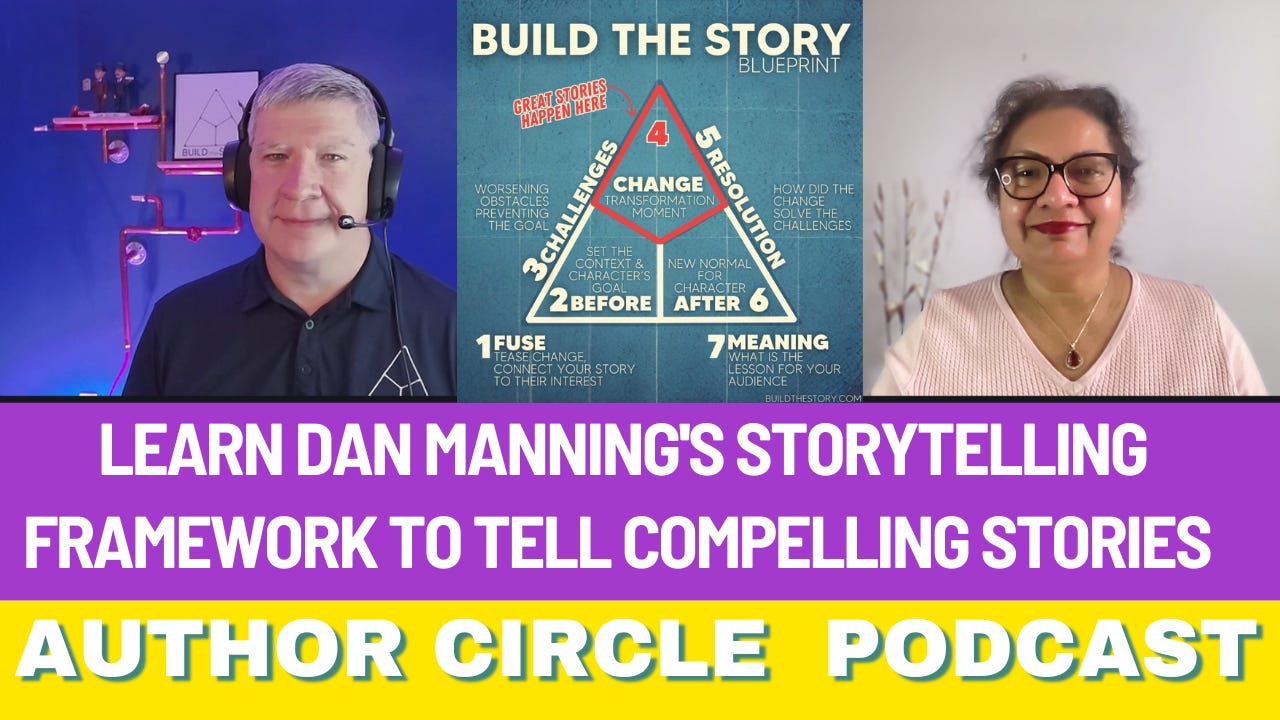
I recently interviewed Dan Manning, a master storyteller and teacher. He has a framework which simplifies the process of turning anecdotes into impactful stories.
I encourage you to check out his interview here.
Stories are everywhere
Remember the scene in The Lion King, when King Mufasa and his son Simba survey their kingdom at Pride Rock?
Together they gaze out at the sweeping landscape—every baobab tree, every ant, every Zebra, every river and watering hole and setting sun and shadow—and Mufasa turns to his son:
“Look Simba” he says quietly. “Everything the light touches. . . . . . is a story.”
There is a pause. A moment ripe with drama, as the cub absorbs his father’s words.
Finally, Simba responds, “Wowwww,” he says, his baby voice brimming with awe.
“Really! They all have a story.”
Okay, I lied. This is not what Mafasa said. But he could have said that and it would have been true.
Stories are all around us.
Every tree, every ant, every Zebra, every river, every watering hole and every setting sun and shadow has a story.
With live and breathe and witness stories all the time.
I just told you a story to make the point.
Most of you have seen The Lion King and instantly recognise the snippet. There are hundred more snippet in the movie which you can use to make your point.
That’s just one movie. You have seen hundreds if not thousands of them. You’re sitting on treasure trove of stories.
Had I told you stories are all around us, the message wouldn’t have registered. But now I have told you a story, with the message encapsulated in it.
Now, you will not forget it.
Even if you want to.
Next time you see The Lion King or see that snippet, you will remember the punch line—Everything the light touches. . . . . . is a story.
Build A Library of Your Stories
Everything you do, everything you learn, everything you see, feel, or witness is a story waiting to be told. You just need to stay tuned to them.
Build a library of your stories, so that you have them ready when you need make a point or to sell an idea or your business or just to make connection.
Consider this as homework for life.
Here are 3 techniques to help you find them:
1. Identify the ‘Before’ and ‘After’ moments in your life.
Have you ever seen the ‘Before’ and ‘After’ photographs in weight-loss advertisements? They don’t need much text—the photos themselves tell the story.
That’s exactly what you need to do with your own experiences.
You can capture them in with this line:
From _______ To ________
Here are some of the From___To___ stories I have written.
From not being able to write To author of 6 books.
From stressed and anxious To calm and productive.
From barely able to walk a mile To walking to Machu Picchu.
From overwhelmed by clutter To living in a calm, organized space.
From avoiding social situations To building strong, fulfilling relationships.
From struggling with unhealthy eating To nourishing my body with balanced meals.
2. Look for the ‘first’ and the ‘last,’ the ‘best’ and the ‘worst.’
Mathew Dicks is 36 time Moth Story Slam champion. In his book Storyworthy he tells to write about your ‘first’ and the ‘last’ and the ‘best’ and the ‘worst’ moments.
They make powerful stories because they mark significant turning points in our lives.
‘Firsts’ are often full of excitement, fear, or discovery, while ‘lasts’ carry a sense of closure or the end of a chapter.
Best and worst moments highlight extremes—triumphs and failures—that evoke strong emotions and connect with others on a deep level.
These moments provide readers with insight into your growth, struggles, and achievements, making your story relatable and memorable.
You can take virtually any topic. Here are some examples:
Your first job, your last job
Your first car, your latest car
Your first kiss, your worst kiss
Your first home, your best home
Your best holiday, your worst holiday
Your first interview, your worst interview
There are stories hidden in all these moments.
3. Write your five core stories.
There are 5 stories that every creator need to master telling them because you will be telling them again and again your success depend on those.
They will help you land clients, get job, write books or sell your ideas.
Your origin story (who are you and why are you here?)
Your transformation story (How did you become good at what you’re teaching?)
Your reflective story (What did the journey teach you?)
Your purpose story (Why are you doing this?)
Your client story (How did you help others?)
Now, the question is how to tell these stories.
A story in its purest form is a complete narrative, about a character who meets obstacles on the way to achieving a goal.
Follow the fiction writing technique.
Use Ash Rathod’s 6P framework to build your story.
Protagonist: Who is this story about?
Present: Where does this story start?
Problem: What is the challenge they face?
Pit: What was the lowest point for them?
Progress: How did they get out of the pit?
Power: How did they regain their power?
I have given you a lot in this article.
You may not use all of it straight away.
So, save it somewhere, so that you can come back to it.
Let me summaries it for you.
We don’t read books for facts and figures, we read them for stories.
Storytelling is not just for your readers, it is for you as well.
Become a life long student of storytelling.
Stories are about change.
Stories are everywhere.
Build a library of your stories.
Use these 3 techniques to find stories.
Identify ‘before’ and ‘after’ moments in your life.
Look for the ‘first’ and the ‘last’ and the ‘best’ and the ‘worst’ moments.
Your 5 core stories.
P.S. Would like me to run a challenge of writing 25 stories in 25 days in 2025?
Let me know and I will organise the challenge in the new year.
That’s all from me today.
As always, thanks for reading.
See you next week.

Author Circle is a community of aspiring authors like you, dedicated to transforming ideas into books and careers. Join us to write yours.
Lemons & Lemonade 🍋
November’s topic is storytelling ✨
Upgrade now to enjoy the full lemonade and join 2 exclusive Webinars to power up your stories and a vibrant community of writers and creators.
Live Chat on Public Speaking and Storytelling
Webinar on Notion to collect, organize and writers stories with Alberto Cabas Vidani
What’s a Founding Member?
My Founding Members enjoy ALL the benefits of my paid subscribers + a 1:1 personalized session focused on vision, strategy and monetization to take your work to the next level.
45 have already said yes 😉
Oh, and the prices are going up in January 2025.