


📍Last days of the early bird offer for my new course The Anti-Procrastinator: mental gym to get unstuck and build habits that stick.
64US$++ only instead of 128 US$++ until 31 May.
To be super honest, I didn’t start posting on LinkedIn to “build a business”, “invest in my personal brand,” or become “the next thought leader.”
I wanted a damn job. I was in Australia, unemployed and separated from my husband due to the pandemic and I wanted someone to give me a title and a salary.
But deep down, I just wanted to be in a place where I was valued and could do something meaningful.
Full disclosure: I never found that place (not a single offer), so I built it myself from scratch.
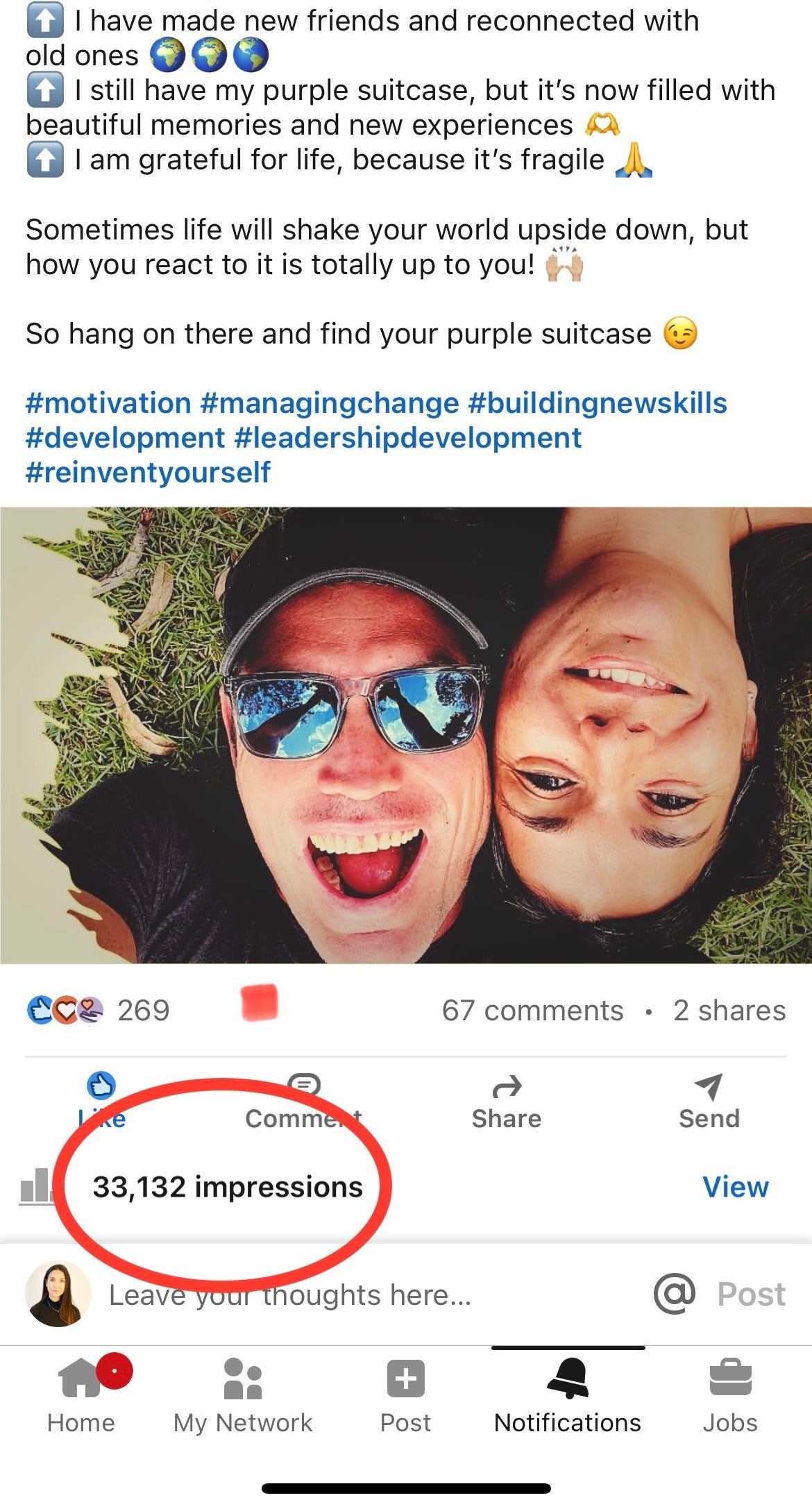
The funny thing is that my first-ever post on LinkedIn went viral. But don’t worry, this is not one of those “hacks to go viral” Post. Pretty much the opposite: My goal today is to share how you can grow a B2B business on LinkedIn (in my case, public speaking), without a huge audience or tons of likes.
A small room by design
One thing I realized very early on is that you don’t need to be huge or go viral to grow a business on LinkedIn. In fact, some of my entrepreneur friends have under 3,000 followers and they are able to generate leads quietly and consistently.
How?
By being relevant and helpful to the right people in the right room.
That means knowing exactly who your ideal client is, what they care about and what issue they are trying to solve. When you speak their language, they listen.
In my case, the right people are Heads of HR, Learning & Development Teams (L&D), People Leaders and DEI teams. They are the ones who will hire me as a speaker/ corporate facilitator. Basically, follow the money.
That means my room is now much more targeted and smaller because I’m not talking to everyone. But that’s by design: I’m removing the noise to focus on quality vs quantity.
Who is in your room?
The 2 things you should be talking about
So now you are in the right room and you have to figure out how to get people’s attention.
There are really 2 main things you should be writing about:
Who you are (why you)
How you can help them (no one cares about what you do; they care about how you can add value to them)
Everything is going to branch out from these 2 topics.
And while this sounds easy, most people get lost here because they lose the balance:
If you only write about your stories and your personal stuff, you build a connection and become likable, but you end up in the “friend zone”. People like you but they won’t buy from you. You might win the popularity contest, but good luck paying for fuel with likes (or without them for that matter).
On the other hand, you see people who share interesting reflections, trends and great frameworks, but that’s all they write about and while they position themselves as “subject-matter experts,” they lack the human connection and it’s hard to relate because at the end of the day, people relate to people, not experts.
To be super honest, I’m still trying to figure out what that balance looks like myself but after almost 4 years writing on LinkedIn 5 times a week, I have had enough mileage and proven failures to build a system that works and that helps me generate 90% of my leads for my public speaking business (the rest is usually directly from my newsletter/ Google and AI search).
This strategy has helped me close deals with amazing clients (the next session is with AXA) and speak at large-scale forums (the next is a global forum with C-level HR executives in Hong Kong).
Content must serve a purpose
People throw content at the wall hoping it will stick, like spaghetti. That used to be my “strategy” and it created a lot of noise (likes) but it didn’t move the needle.
The big mindset shift is to realize that each piece of content serves a different purpose. Once you understand that, everything else flows because content becomes a channel and you can start with the end goal and reverse-engineer.
These are the 4 types of content I use to serve 4 different purposes (examples below).
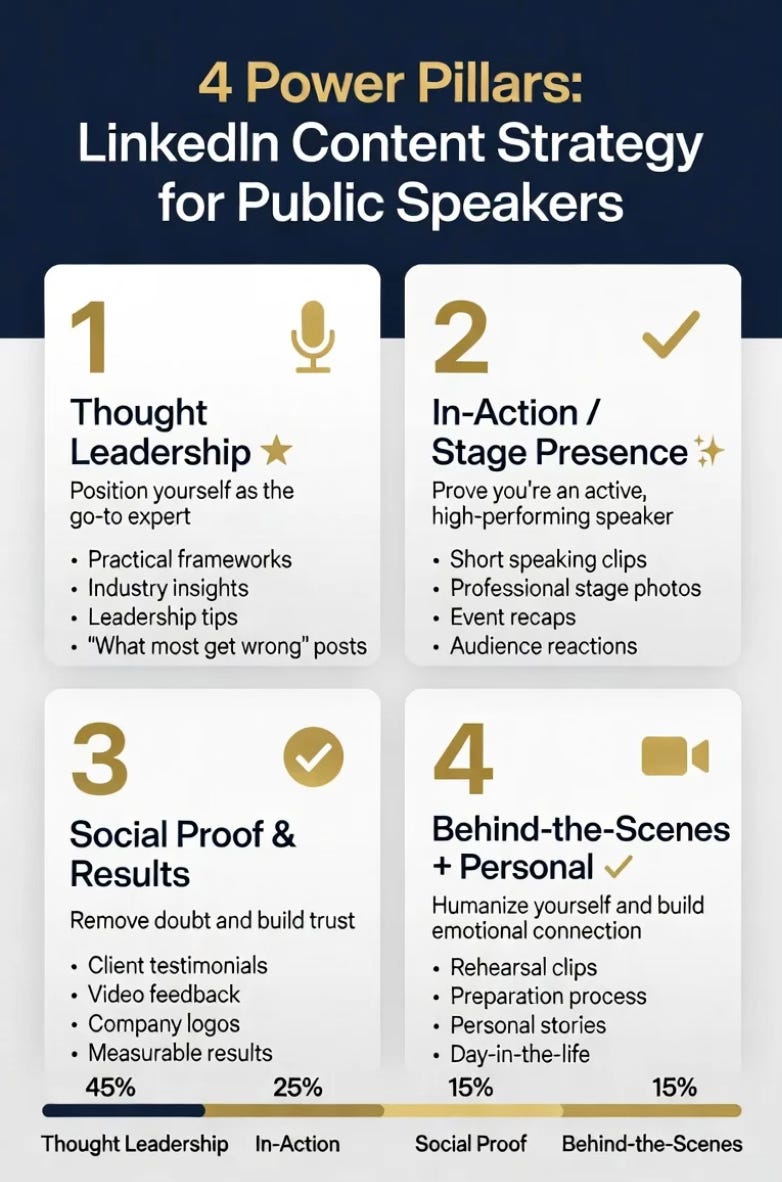
1. Build authority → Thought leadership
This type of content positions you as an expert in your field:
- Reflections on your topics and predictions
- Your proprietary frameworks and strategies
- Assessment of policies and trends
- Tactical tips and how-to
If your topic is change management, you will share your strategies to help organizations drive change.
If you are a wellness consultant, you might share tips to prevent burnout.
This content is key because it demonstrates your knowledge and helps you build authority. It’s the core of your business.
Risk: Don’t just share what you know or you’ll become a boring/ pedantic professor who gives lectures all the time.
2. Show how you work →In action
This turns theory into action, the good old show vs tell.
When people see you on a stage with a mic, it just clicks.
But this applies to any field because it shows what you do.
If you are a coach, you can show how you work with your clients.
If you are in sales, you can share a real example of a tough negotiation.
If you teach a skill (e.g, AI), you can demonstrate that skill in a video.
Find the angle that helps you turn your knowledge into something visible that makes people go, “Ah, I know what she does!”
Risk: if you only post action stuff, it can become a bit shallow (“the show gal”) so this complements well thought leadership that goes deeper (point 1).
3. Build credibility → Social Proof
This is the underdog. Personally, I find that having third-party credibility and being endorsed by real clients will become more and more relevant in the future.
“Thanks” to AI, trust is at an all-time low at all levels, and people are lying more than ever because they can: there are no checks and balances, so there are fake degrees, fake claims, fake graphs, fake rankings and even fake people.
I recently saw a random Jonno dude post a ranking of “The best DEI Speakers in Asia”. He tagged me as #6 but guess who was number 1…I couldn’t make this stuff up but I can call out BS when I smell it. So I did.
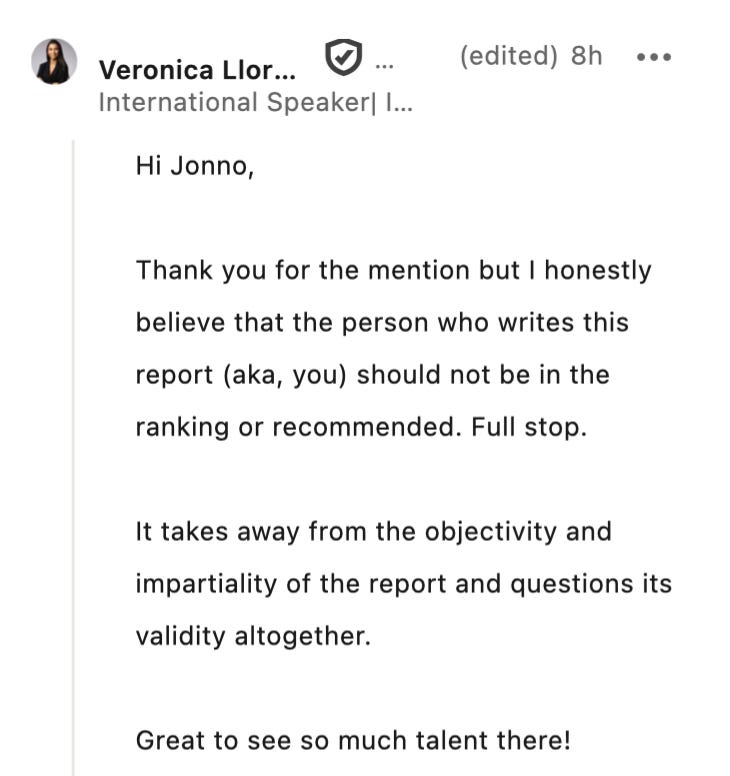
Because of people like Jonno, nothing is more powerful than a real client sharing a real testimonial about what working with you is really like.
What you can share:
- Reviews and testimonials from clients (qualitative results)
- Measurable impact: cost savings, higher NPS, poll results (quantitative results)
- Success story: how you helped a company go through a restructuring or how you helped a manager be promoted to a senior role.
- Failures: what?! Yes, sharing your failures and what went wrong gives you credibility because it shows you speak from a place of experience but also vulnerability.
Risk: If you only share wins and successes, it can come across as arrogant. Try to balance the wins with the lessons, failures and the journey.
4. Build connection → Personal and Behind the Scenes
This is the most fun content to create because it’s about you, the individual, your hobbies, your daily life but it’s also a slippery slope.
It’s very tempting to share a motivational quote from Maya Angelou, a picture with your dog, a travel update, or a sunset in Bali because, honestly, everyone loves those (people who don’t like dogs are not to be trusted).
But when you only post about yourself, you confuse people because they like you but they have no idea how you can help them and so you become very visible and very irrelevant.
I, for one, post a lot about my personal life, from triathlon to being a mom, traveling and languages, but I always keep in mind who I’m talking to and how this can be relevant. For me, the answer lies in values.
When I post about my triathlon races, I’m talking about discipline and resilience.
When I post about being a mom, I’m talking about family, legacy and gender opportunities (I have 2 daughters).
When I post about personal failures, I’m talking about vulnerability and self-improvement.
When I post about my travels, I’m talking about curiosity and openness to other cultures.
All of these are relevant because they talk about values I bring to my work. It matters because values are the strongest common denominator between humans. It’s how we truly connect.
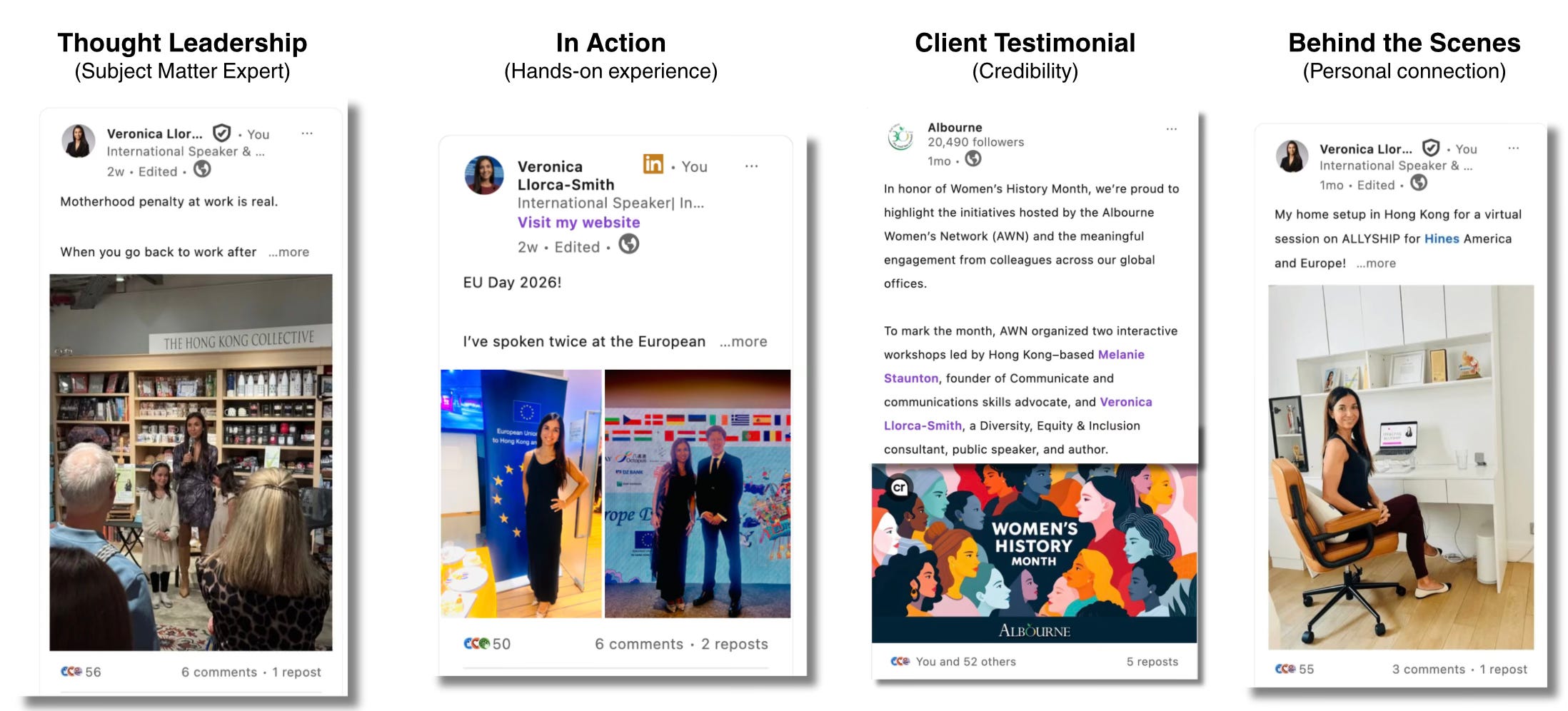
To wrap up today, here is a sample of each content type. Not loud, not viral but it works because I’m talking to the people in my small room. And they listen.
If you’d like to connect on LinkedIn, you can find me here.
Lemons & Lemonade 🍋
🎤 Public Speaking Bootcamp: Last day of the early bird.
If you want to turn your expertise into a corporate offer through public speaking, join my group program to become a public speaker and get paid to deliver B2B sessions and workshops:
✔️ How to pick your signature topic (what sells)
✔️ Infrastructure to build your speaker brand
✔️ Strategies to build a B2B offer (types of sessions, pricing, formats…)
✔️ Content and SEO strategy to boost discoverability
✔️ Lead generation and how to find clients (inbound and outbound)
Due to popular demand, I’ll have 2 Bootcamps (three 90-minute group calls):
- America-Asia Pacific: 15, 16, 17 June 8 pm EST
- Europe-Middle East: 16, 17, 18 June 8 am London
Find out more about the bootcamp and who is joining at The Lemon Tree Academy 🌳🍋🎓
Really love the way you position yourself and the structure of the post. Planning to apply this on a day to day basis ✨
Especially the connecting with people part.